Thursday, February 17, 2011

WV need a Renewable Portfolio Standard


West Virginians with solar installations may sell their solar renewable energy credits (SRECs) to the District of Columbia, Pennsylvania, and, Ohio. This monetary reward, up to 34 cents per kilowatt hour, helps to pay off the upfront costs of installing your own net metering PV system. It is essential to have this benefit to increase West Virginia's renewable energy content.
Since WV has no Renewable Portfolio Standard (RPS), we are at the mercy of other states to toss us a bone. The inclination of eligible SREC state markets is to prefer in-state installations first, then turn to outside sources to meet their needs. This puts WV installations as second rate and yields less value for your investment.
The answer to providing continued benefits for WV PV, is to have our own RPS legislation. I'm not sure how to promote that exactly. Do we pressure the WV Public Service Commission, our local representatives, or some entity in Charleston? (maybe all, or yet more?)
Please respond to this plea by offering methods (via comment) to make WV step up and get in line with this important legislation for our future.

Friday, January 21, 2011

Solar Powered IRAs


We just sold our first two SRECs (Solar Renewable Energy Credits) which are 1 Megawatt/hr blocks of energy from our PV array. The buyer actually does not buy the power itself, but the right to call it their renewable energy. We used all that power at home already for free, so its like getting paid twice at 2 to 3 times the going rate. The lucky buyer was Washington, DC for $250 each. We can also sell to PA and soon Ohio who has the best prices (~$300+)
Now that it has actually happened, after waiting 6 months, it gives me a renewed interest in adding capacity to our system. Our plan is to add a 6.9kw linear array across the pond dam. (see array further away in image) The two pedestal mounts by the willow tree are what we have right now and are rated at 3.6kw for both pedestals combined. Our total will become about 10kw capable of producing about 13 SRECs a year. The plan is to stuff that money away in our 2 IRAs for as long as the party lasts. We also get a 30% tax credit from the Feds and $2000 tax credit from the state of WV.
The capital for this installation comes from an online joint trading account we have maintained for years. Now that the market is up, we intend on liquidating part of our portfolio that has yielded good gains. One of those holdings is a domestic oil/gas field salvage company called Linn Energy. (LINE, stock symbol) It is both ironic and symbolic that we are taking the profits from petroleum and investing in solar. The whole country should be doing so by raising fuel taxes, enacting a carbon tax, and stopping subsidies to big oil and apply those funds into furthering incentives for alternative energy. According to my calculations, we can expect 8% to 25% (at much less risk than the stock market) return on our money depending on installation costs and future SREC and electricity prices. Any capital gains or dividend taxes are offset by the tax credits for PV and IRA investments.
But it doesn't stop there. We will have twice the generating capacity of what we currently use. The plan is to install a heatpump to replace our propane heat supplement. (we also burn wood) No more propane except the cook stove. Yea!
With all the incentives and the fact that electricity and propane prices will rise steeply over the coming years, this system makes sense to us. As we get older, we will appreciate the free energy (system payback in a few years) and yearly contributions into our IRAs. PV isn't instant grats, you must look out 5, 10 or 20 years. These modules should still be puttin' out in 50 years, although I most likely won't. Then there's my grandkids..........hmmmm

Power Bill

This is our power bill for December 2010 showing that we finally bought some net grid power from Allegheny Power (264KWh) Ever since the PV net meter system went online back in June, our bills have been virtually zip. Its hard to tell what we used per month last winter and spring because of the over-estimates the power company used. They are now required to read the meter every month and the net metering data is hand calculated.
This kind of bill is only possible with a 3600 watt array if you also have your usage under control. Its not hard to do, just upgrade lights, appliances and behavior. It took two years to trim our use so PV made sense.

Sunday, January 2, 2011

New West Virginia Energy Source


Research produced by Southern Methodist University's Geothermal Laboratory, funded by a grant from Google.org, suggests that the temperature of the Earth beneath the state of West Virginia is significantly higher than previously thought and capable of supporting commercial geothermal electricity production. As seen in the above maps, which shows temperatures from 4.5 to 7.5 kilometers deep, a large area is at least 200 degrees C. (392 degrees F) This is plenty hot enough to run steam turbine generators. Previous maps showed the orange areas as green, not hot enough. This WV source could be the largest geothermal field east of the Mississippi, ready to distribute power to highly populated areas in the east.
If only 2% of this renewable energy were utilized, it could be in excess of all of WV's generating capacity from coal. (about 16,000 Megawatts) However drilling this deep with existing technology would be very expensive. Research is in high gear to develop a new type of drilling called hydrothermal spallation along with a technique called Enhanced Geothermal Systems which helps to extract heat from the hot dry rocks in the form of steam or hot water. This technology should be available in a matter of years, not decades.
Once again, WV will have another resource from underground. This time it can be clean, green, and infinitely renewable. (At least in the matters of the human race) Did you know that WV has an Official State Rock? (really) It's coal...maybe it could be changed to Hot Rocks instead?

Wednesday, December 29, 2010

Power Production Update


At the end of November we had a surprising 400-some KWh in credits on our meter. After 28 days of snow and clouds, I suspected we would have burned that up by far. When I checked the meter 12/28, I saw we had finally bought 122 net KWh from the grid. I never thought we could get this far into winter before dipping into the grid. The gridtie system has performed beyond expectations here in the West Virginia hills and hollers. Can't wait to see when we get back into credit territory.

Monday, December 20, 2010

Return of the Sun, Eclipse of the Moon.


Ever since near the end of November to present, our weather has been unusually cold, snowy, and cloudy. It's the kind of weather you would more expect in January. Needless to say, it really knocked a hole in our PV production. Our predicted harvest was for 216 KWh, the lowest month of the year. So far, we have only captured 96 KWh and it is the 20th already. This is where the climate averages play in. Even though this month is bad, last month was well above average. That's why you can't get freaked out over unusual circumstances with solar, it all works out in the long run.
One thing to celebrate is the Winter Solstice on the 21st. It is symbolic mostly, however it does mean that the sun will be rising ever higher and the days become longer. That's about all we can reinforce ourselves with as we enter January and the bottom of winter. By March, we are predicted to produce 435 KWh, twice as much as December. I think that's plenty to look forward to.
As an interesting note, around 3am tomorrow morning, there will be a total lunar eclipse. It will be the first one to fall on the Solstice in over 400 years and we can all witness it as long as it's not... CLOUDY.

Saturday, December 11, 2010

Shadow Study

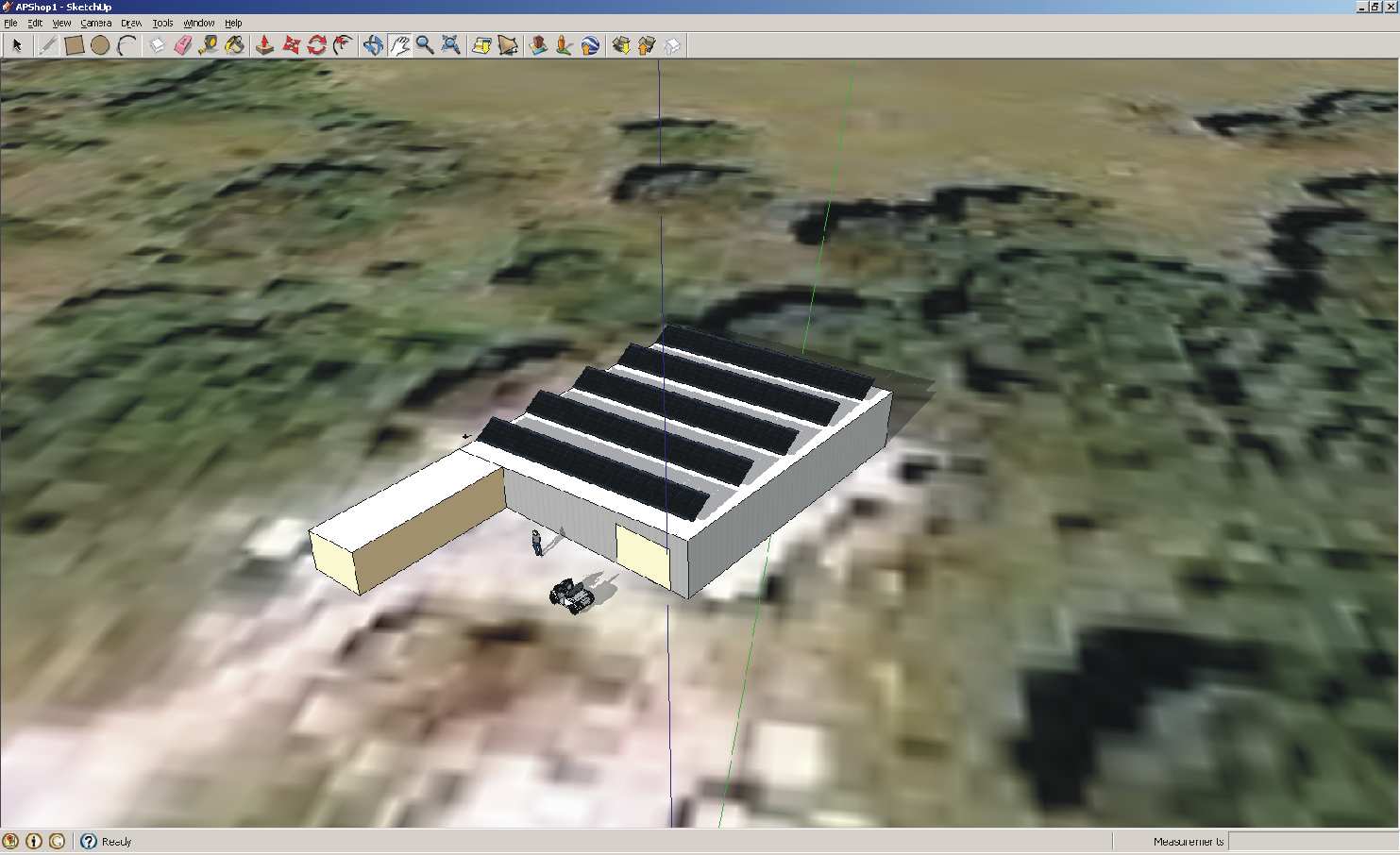
One thing you can do on snowy days is to explore the capabilities of your computer. I regularly use Google Earth to study PV site for potential customers. This time I decided to model our proposed shop PV array using Google SketchUp (free, google it) The sketchup program can use Google Earth data for shadows and geophysical features. There's a control where you can set anytime of the day, any day of the year, to see how the sun's shadows affect your array. Even nearby mountains will cast their shadows accurately.
I wanted to confirm my row spacing for maximum module density without interference. It takes awhile to get a handle on modeling in sketchup, but its time well spent. I will use this tool to prove the design is good for a grant we are pursuing and see how roof angles and protrusions may influence some future complex new install.

Winding Down


After finishing the job described on the previous post, I thought there would be a quiet period while winter ramped up. To our surprise we started a job on a new home site by setting poles for a top of pole PV installation. We'll try to get all the conduit laid while the builder is there with excavation equipment. At some point he'll have to shut down during any severe weather. We'll pick it up again when the weather returns to bearable.
It's been unusually cold and cloudy for the past week and we're using our last couple hundred KWh's in credit on our meter. To our further surprise it looks promising for another PV job where the owner wants to spend the money this year for tax purposes. We'll work on that one as the weather opportunities arise.
In the photos above you can see the pole fabrication in progress. I want to thank Lola Alderman for helping and doing a fine job on finishing. By the way, that's my new forklift I got to unload trucks delivering pallets of PV modules. In fact, its only new to me, it has some hours on it and I had to rebuild some linkages and fit chains to the tires. We couldn't afford a forklift that didn't need fiddling, so I'm happy to do it. It runs well and we might even paint it.
The pic of the PV array is the one at our house after days of snow showers. The deep blue sky is a wonderful sight. I didn't brush off the snow so I could see how it melts and slips off with a little sunshine. It took 4 hours to clear itself that sunny morning.

Tuesday, November 23, 2010

Final Day On the Roof


Due to the fact a recent customer decided to get a new roof before we install, and waiting on back-ordered parts, we are finally here on November 22nd for the panel installation. Ominous weather forecasts and Thanksgiving pushed us to work on the weekend and Monday to get off the roof part of the installation. As you can see the weather was perfect that day. Now, all thats left is the homerun wiring and disconnect that aren't so weather critical.
This is a grid tie net metering system with 24 modules rated at 220 watts for 5280 watts STC total. The inverters are Enphase D380's that connect to two modules each. This made wiring simple and less expensive than traditional systems. After inspection, our power company must follow through with their end of the deal. They have been rather slow about getting the new meters installed lately, and we hope sometime in December our customer will be enjoying the benefits of solar power. That will be the weakest solar month of the year for production but they can look forwards to really gaining output as the season progresses. This system should harvest 6 MWh/year given his exposure and some trees in the way in the morning and evenings. His SRECs should yield $1800 a year not including the "free" electricity.
Speaking of weather, I looked at our meter today and was surprised to see we had 460 KWh in credits. I can only attribute that the ongoing drought has produced more than usual sunny days and we have not used as much electricity. Next week is December and I suspect we will use those credits up if the cloudy days come. None the less, I am delighted we went this far without using net grid power.

Wednesday, November 17, 2010

Getting Better


The image is from the Open PV Project of the National Renewable Energy Laboratory. It shows the national average cost of an installed PV system at $7.15/ watt. Our last few installs worked out to be about $5.50 to 6.00/ watt. These were projects that were pretty straight forward roof mount, grid tie systems. Special mounting options or offgrid installations are more expensive.
Our selection of the latest technology and reduced panel prices have contributed to making solar more affordable. Being able to take advantage of the tax credits reduces the cost even more.
Let's hope America continues to promote all types of renewable energy for far into the future. We need it.
Alterra Renewable Energy

Thursday, October 28, 2010

The Evolution of Lighting


When I was a kid watching Voyage to the Bottom of the Sea on TV, there was a scene that facinated me so much, it is clear in my head to this day. In the 1965 episode called "The Invaders" Robert Duvall played a being from a 20 million year old race that disappeared from Earth. The scene shows Commander Lee Crane getting acquainted with this advanced entity. The being reached up to a light fixture in the submarine and said:"your lights emit unnecessary heat". Followed by: "you have not learned how to conduct electricity without...wires?"
Somehow, those lines made an impression upon me and how to gauge what the future would be like.
Today, with the availability of compact florescent bulbs with good efficiency and being relatively inexpensive, that was the first improvement over standard incandescents. I knew we were finally on track to becoming an advanced race. I'd been waiting 40 years after all.
CFLs are a step in the right direction, but they are still relatively inefficient, thus giving off a fair amount of heat. I was walking through Lowes the other day and stopped by the LED shelf to see how that technology/cost is coming. I saw that a 40 watt equivalent, 8 watt actual, was available at around 19 bucks. Much better than even a few months ago. I bought one.
When I got home I was anxious to screw it in a lamp socket and perhaps have light without heat. After waiting a while, it got warmer and warmer, but still cooler running than a CFL and vastly superior to a scorching incandescent.
We're not yet in the future as I have been waiting for, but there are substantial improvements in conservation ready to use. LEDs hold the best promise once efficiency is improved. Right now, a LED lamp boasts 50,000 hour lifetime. That would be like burning 5 hours a day for 27 years. Think of how many CFLs (8000 hours) and standard bulbs (1500 hours) would not have to be made and replaced. LEDs do not contain mercury like CFLs and the emissions from a coal fired power plant. More conservation, less emissions, less mercury.
Let's compare the costs of installing a solar electric system to the different types of bulbs discussed. The basis will be 5 hours a day for the bulbs and 5 peak sun hours/day for the PV. The current cost per installed watt of a PV system is running around $5.50/watt.

40 watt incandescent-retail price: $1.50- daily consumption: 200 watt/hrs.
Cost of PV system to run it: 40 x $5.50=$220.00

40 watt equivalent, 11w actual CFL- retail $4.00- daily consumption: 55 watt/hrs.
Cost of a PV system to run it: 11 x $5.50=$60.00

40 watt equivalent, 8 watt actual LED-retail $19.00- daily consumption: 40 watt/hrs
Cost of a PV system to run it: 8 x $5.50=$40.00

Although you really couldn't or even want to install such a small (40 watt) grid tie array, this is just looking at a slice of the consumption/production ratio. Conventional wisdom in PV land is that for every dollar spent on conservation, you would save about 4 or 5 bucks trying to make the power yourself. If you have huge power bills, a substantial PV installation would be a disappointment. If you work down your usage, the PV investment will represent a larger percentage of your consumption and the experience will be satisfying. By the way, I just checked our power meter on Oct 25th and we had 490 kWh in credits. I was totally amazed we were "still in the black" coming up on November. We have not used any net grid power (read: no power bill) since we went online June 8th 2010. This is only possible because we reduced our use over the previous two years. It not hard, it just takes discipline and smart choices.

Wednesday, October 27, 2010

PV and the State of the Economy


We have two nice PV jobs to get done before the snow flies. Timing is everything in the logistics of pulling the various parts together on the sites. In the past, its been a matter of placing an order with a couple of suppliers and the parts would show up in a reasonable amount of time. As this year marched on, I noticed the cupboard shelves for PV parts getting a bit thin.
The past two weeks I spent an inordinate amount of time emailing and finding alternate sources for the required parts. Some of the parts have a particular spec that affects another part's compatibility. So, it cascades though your parts list, if you change one spec in order to get the job done. All this adds stress to my job and it seems the suppliers have no remorse for the inconvenience.
My theory is that industry and corporations are hoarding cash to hedge any uncertainty in the future economy. They reduce their inventories, cut costs, and production so they don't spend as much money. This means they're not much into hiring either. Those reduced supplies trickle down to the distributors and me, the installer. The banks are the same way, reluctant to lend money while they are sitting on huge cash reserves.
No amount of stimulus will undo this mindset. If our economy is to proceed, big business must boost productivity and hire more personnel. Until that happens, our economy will just flounder along and the consumer will have no confidence to invest in solar or efficiency improvements into their lifestyles. Someone must make the move.
On the benefit side of our lousy economy, PV module prices have dropped dramatically over the past year or so. Last summer module prices were about $3.50 per watt. This year we are selling at $2.50 per watt. Part of this was a glut in supply caused by everyone jumping into the PV manufacturing business, especially the Chinese. On the other hand, the consumer pulled back on actual spending, even though interest in renewable energy is spreading through our country.

Friday, October 8, 2010

Solar back on the White House


Well it's finally happening, Obama has decided to mount solar electric and thermal on the roof of the White House. Actually there are small installations on the grounds, but they received little fanfare from the press.
http://news.yahoo.com/s/ap/20101005/ap_on_bi_ge/us_white_house_solar_power
The picture at the top of this page was composed earlier this year as I had the dream of being the installer. I tried many emails and maybe one got through to him. There were several groups putting the pressure on to make it so.
So far, I didn't get any calls to do a site assessment for the White House, but I'm faintly hopeful.

Sunday, October 3, 2010

Sooo Wrong


Tenley and I were driving to a site assessment when we went by a school zone. After getting past the first sign and towards the end of the zone, I realized that the PV modules where pointing towards each other. We were on a north-south highway, so one of the modules was bass ackwards.
If you look to the left in the distance you'll see the correct one facing roughly southwest. If you look to the right side you will see the pv module looking northeast. Only a summer sunrise will barely light it's face and in the winter, not a chance. This module will only gather a small fraction of the solar energy from back scatter in the atmosphere. I don't know if this is a new installation and the shortcoming not yet realized or it has enough reserve to keep functioning during the school year.
If you study the sign on the right you'll see that the pole is not tall enough to turn the module around. There was also some attempt to force-twist the frame further east. Who ever installed the signs went ahead with the short poles and hoped for the best, it was time to go home for dinner. It looks to me like the frame could be swiveled much further east to acquire more gain. The correct answer is to put in a pole about 3 or 4 feet taller and swing it around due south without blocking the signal or sign.
Best practice in solar installations is to be within 20 degrees either side of south. In a pinch up to 30 degrees off is acceptable with only about 4% loss of energy harvest depending on module tilt.
Solar installations are just starting to become popular so there are not many experts out there. But in a situation like this it ought to be a no-brainer....

Friday, October 1, 2010

PV Announcement


We have decided to pursue an ambitious solar project at Alterra's shop building. The project involves 20 kilowatts of installed generating power to the roof of the shop. This installation will be one of the largest to date in West Virginia. It will be able to produce enough surplus power (25 Megawatt-hours/year) that we can get rid of our propane heat and have plenty left over for AC, daily operations, and future expansion. The generated power will produce a cash flow to payoff a short term loan as long as we also get two different grants. After its paid, the system will produce substantial income for years to come.
As the pieces come together, we will be reporting on the progress. We have already started roof preparation and reinforcement for the weight. We also have a work request number with Allegheny power who we will net meter. There's a lot of design and paperwork to go but we think this plan is worth the effort. Stay tuned as this plan comes together. It is especially valuable for small businesses.

Friday, September 17, 2010

The Tale of a PV Installation, Part 2


Where was I......Oh yeah, I was at the beach while Hurricane Earl clipped by. No internet, no need. When we got home, it took 4 or 5 days to become officially caught up with unfinished business. Now for the rest of the story.
We left our heroes in the blazing sun assembling the PV modules. Our progress was pretty smooth until around noontime. By then it was 90 and humid. Plenty of water was dispensed with retreats to the shade trees. Originally, I decided upon two morning stints to get this part done. We were finished with 3 out of 4 arrays and the boys wanted to push on. I reluctantly agreed.
It wasn't long before I heard fasteners and tools begin to tumble off the roof. I knew the heat was bearing on the roof guys. I had to demand they take a break with only two more modules to go. Once refreshed, we pushed the last bit of energy to complete all 20 modules. Joe had to stay up to make final connections at the roof junction box. It seemed like an eternity but he was quite the athlete pushing through. When all were on the ground we all felt pretty good about today's accomplishments. Time to gather the tools.
I walked back into the yard to get a wide view of the installation. One of the owners asked me why the last column of modules looked askew. I looked from different angles and by golly, they were off by under an inch. I sort of groaned to my self knowing we might have to realign that day in the heat. So we tried offsetting modules to close the gap. It was soon apparent 4 of 5 must be removed and the starting module aligned correctly. I told the customer that I need to think about it a bit. We had gained nothing by pushing through the last column in the heat. Fatigue dulled our eyes and brains. We'll have to come back anyway. Lesson learned.
But hey, we could give the system a test! We started the Envoy (array interface) and the microinverters. I takes time at first while the microinverters report to the Envoy and it starts logging in the units. We waited a half hour but only came up with 10 units. Something wrong. We checked the branch box and reset the breakers. Nothing. Then I asked Joe to put a meter on the output side of the breakers. One of the two was dead. Joe and I have never bought a new breaker and have it bad, but there it was. Joe offered to run to town for a replacement. He was back in no time and installed the new breaker. We flipped them on and and went back to the Envoy. In a few minutes we had 15 or so and a few minutes more, all 20! Great, we were pumping nearly 2800 watts, everyone felt happy and relieved. So we shut the system down and told Glenn its in the power company's court and that we would return in a few days to align the modules. Meanwhile, I contacted the electrical inspector Ray Still of Alderson, WV. He contacted Glenn, made arrangements, and he was on site that evening. What good service. The system passed all codes and requirements.
Early the next week, we all showed up to tweak the modules. After an hour or so, we had them true and we were done with the job. Glenn and I discussed the power company's inaction and promised I would call all my contacts to find out the status. I found out that we have a work order number, but no $30 application payment or inspection report. I knew both items were taken care of but they didn't know it. Glenn was starting to get a bit annoyed at the power company. He would say;"I have these panels on the roof and all this sunshine is going to waste!" I assured him that the sun has been burning for 6 billion years and we have quite a few billion to go. I know his feelings exactly. It happened to me when I was waiting for our system to go online.
Glenn and I finally figured out we were getting the runaround. With both of us calling and emailing everyone finally someone from the local office showed up to check the meter base. All I could do is assure Glenn it will all happen, eventually.
And eventually it did, while I was at the beach. Glenn now turned compulsive, reading the Envoy and checking the new bidirectional meter readings. Once again, I've been there. It is one of the most rewarding experiences of having a PV system. It feels all warm and fuzzy.
I hope that as PV systems are installed in the region, the power company will be more friendly, accepting, and knowledgeable about this upcoming change in the way they have been running the grid.
I am happy, Glenn and Susan are happy, and anyone else involved with this new wave of independent power. A better word may be distributed power as opposed to centralized. Power to the people!

Friday, September 10, 2010

2nd Report, Net Metering


I posted a progress report back on August 20th showing our 183 kwh credits with the power company. Yesterday, Sept 10th, I took the above pic showing us with 333 kwh in the bank only 21 days later. What helped us to pack it on was a change in the weather pattern to dry clear days. We have been producing 20 to 22 kwh on most days for the past two weeks. Another important factor was that we were away from home for 10 days thus reducing our demand. It's these kinds of circumstances that can gang up to produce twice what you expect. Then there are the times when things gang up and disappoint.
When living with solar, you'll have your ups and downs on the short term. We calculate future production with the solar aperture and long term climatological data for the site.(plus other things) For sure, the slate gray skies of winter will be a bummer, but you'll be prepared with hopes of near term improvements.
Back on the August 20th post, I mentioned we were running behind due to a cloudy pattern that month. Our prediction was for 497kwh and the partial month's data suggested 446kwh. What we actually closed with was 476kwh. We'll take that.
If September's weather stays the same we could see near 600kwh for the month. Of course, by then we would be in drought conditions, not good.

Tuesday, August 24, 2010

The Tale of a PV Installation: Part 1


Back in July,I received a phone call from a couple interested in PV net metering. They were at a local HVAC business called Total Tech in Frankford, WV. As it turned out, they were finishing business concerning a geothermal heatpump system just installed at their new house. Wayne at Total Tech referred us as solar installers. I said sure, come on up, its only 9 miles up the road.
When they arrived we introduced ourselves and I began to query about their needs, desires and home site. This info gives me a better handle on what to present as options for system design.
The couple's names are Glenn Freeman and Susan Mitchell and they are in the process of moving to their new home on Muddy Creek Mountain in Greenbrier County, WV. They are retirees from New Jersey and was just a matter of a couple weeks before they say goodbye to Jersey and hello to West Virginia. It must have been a brave decision to make such a commitment. I think they will adjust well to the local mixed culture and what the mountains have to offer.
Anyhow, we sat in front of my computer and scanned Google Earth for their home site. The aerial photo was dated but we did find the clearing in the woods where the house sits now. I was a bit concerned about the ring of trees shading the array, so I suggested an on-site assessment.
Once I arrived, I was quite impressed with the style, quality, but appropriate size of the dwelling. Previously they had a solar consultant recommend siting, orientation, and roof pitch for the architect and builder. With the geothermal heatpump delivering 4kw of heat for every kw put in, they reduced their demand so that the PV array would provide a substantial contribution percentage-wise. We came to the conclusion that a 3600 watt array was a good starting point while having enough capacity built in so they could easily add 1800 or another 3600 watts over time. After taking some measurements for solar aperture, looking at wire run options, and roofing material, I told them I would be a couple days before presenting the results.
Back at the office, I plugged in the data into a program I assembled to provide performance, cost, tax incentives, and potential SREC value. SRECs stand for Solar Renewable Energy Credits and can be auctioned off to utilities in surrounding states. These utilities will pay up to $0.33 per kilowatt hour you produce instead of installing RE mandated content in their own grid.
Once satisfied with the general design and results, I emailed the docs to them. They soon called and said they were interested. Once I received an engineering deposit, I proceeded to create a detailed hard quote, wiring diagram, and agreement. I went to their place and discussed the details and answered questions. Upon signing the agreement, I requested a deposit and gave them the document to apply for net metering with Allegheny Power.
As soon as I got home the deal went into high gear. I researched availability of the parts through my various distributors to get the best prices and shipping costs. Once decided, I pulled the trigger and made the orders. It didn't take long for the smaller parts to arrive via UPS. The modules had to come by truck, so that took longer.
Once I had the mounting system in hand, which is a clamping system for standing seam roofs, I began to doubt whether they would work. So I drove back to the site and tried one on the seam. It didn't fit...crap. Instead of parallel, vertical seams, these had a truncated triangle profile. No amount of crushing or modification would make for a strong connection. Plan B.
I immediately ordered some UniRac SolarMount rails and clamps. These had to come by truck, so I put the hot rush on it. Meanwhile, I got a RMA to return the other mount system (at a 15% restock charge). The rails got here in a few days, no time lost. This was all my fault for not inspecting the seams closer. I figured standing seam was standing seam. These are the kind of gotchas that happen when you fail to focus on every detail even if you think you know what's going on.
By the time I had the rails and microinverters, it was blazing record hot for weeks around here. Add to that the brown tin roof and the installation windows were mornings only.
In a moment of inspiration, I thought why not populate the rails with the microinverters and roof anchors in my shop? That would prevent a lot of roof time precisely positioning the components on 130 degree tin. It took half a day on the workbench to mount the parts.
So we scheduled a rail install day and got them all up in a few hours. And they where pre-wired and pre-grounded boot!
In the meantime Joe, our licensed electrician, began to run wires in the house and mounted a breaker/disconnect box on an outside wall. He took the wires though the attic crawl space ready to punch through the roof once the modules are mounted.
My wife, Tenley and I delivered the modules on a Saturday since our truck had to go to a garage for a week. Susan and Glenn helped us lift them over the porch rail and made a neat stack. We strapped them together and covered them in case some rogue wind came through before the install.
I kept watching the NOAA weather forecasts online looking for a day with some heat relief. No, just relentless heat as far as you could see. I decided to break the module install into two mornings. Once we got there, there was dew on the roof (can't win for losin') After progressively toweling down the tin, we mounted the two grab ropes to assist our traction.
The first few modules established the flow required to be efficient. Like; where someone was at a given moment, what small parts in the belt bag, tools handy, knowing where the grab rope was, and getting the position of the first module straight and square. Our boots-on-the-roof guys were Joe the electrician, and Michael our electronics tech and fabricator. I was on the ground trying to think ahead about any glitches and providing parts, modules, and tools.
This is the end of part one, part two will be posted before too long.

Monday, August 23, 2010

Proof of concept, Labor of love


When we first installed our evacuated tube solar hot water system, it got me thinking about the heat we had to dump because we had to keep the water tank below 170 degrees F. The other piece of intriguing information is that these tubes could attain a temperature of 375+ degrees if the glycol solution was not flowing.
As we were enjoying the abundance of solar domestic hot water available, my mind kept thinking about other potentials for this high temperature fluid. At first, I thought about steam production to run a steam engine and in turn a generator. I have done extensive prototyping of variations of steam schemes that would make a carefree power source. I never even got close. Steam power requires constant fiddling and water freezes at 32 F., not a practical source of continuous power.
A few months went by and I remembered the Stirling hot air engine.(invented in 1816) No water, no freezing, little maintenance. Not only that, but efficiencies well above steam engines. (up to 40%) My search commenced for a model Stirling motor at modest cost.
Being a machinist and needing some mental diversion, I found a kit that requires machining to assemble from Grizzly. http://grizzly.com/products/searchresults.aspx?q=stirling&new=1
The vertical kit cost 77 bucks, the premachined kit was $164. I opted for the more challenging raw kit knowing I had to convert the metric drawings and some of the material stock to decimal inches. After 3 weeks of part time machining, I got it to a testing level. I put an alcohol burner under the hot end and waited. A little nudge on the flywheel and she started spinning. WOW!
So, I went through a procedure of timing and lubricating until I achieved a speed of 1770 RPM. Wow again. I looked at the size of the flame to the output and thought, this ain't bad.
Once I had a functional engine, I thought about how to power this thing from the sun. Previously, I thought about a huge array of tubes circulating mineral oil at high temperatures to power a more powerful engine. This engine was not in that league, so a more doable solution was needed.
I had Sunda 7 foot evacuated tube with a heatpipe delivery system. The business end can approach 400 degrees when exposed to the sun. So I made an aluminum connector (heat conductor) between the output of the tube to the input of the engine. This will conduct the gathered heat into the engine. (with the aid of a heat conductive paste) I finished up at the end of the day and frantically set up the rig on a board looking at the diminishing sun.
It was already 5:30 pm and the sun was getting weak. I waited for a few minutes and spun the flywheel. It spun eagerly but eventually stopped. Again and again I nudged it hoping for something, anything. After 5 minutes or so, I nudged it and viola, it kept running. As time went by it went faster and faster. Not as fast as the alcohol burner but an impressive seven hundred-some RPM....... Success, Proof of Concept.
The video captures this moment. The video does not capture my elation. It didn't matter that it was no barnstormer, it ran from the heat of the sun. All this work leaves me with a bit of fertilizer for my brain. What I made couldn't power even a laptop, maybe a cell phone. Got that picture in your mind? How convenient.
From here, I'll think about how to upscale this deal. It might have some application, but I'm not betting on it. It will become whatever, this is how innovations evolve.
Before you get carried away with the potential, let me list the ups and downs of this apparatus:
ADVANTAGES:
> Any substantial non-petrol heat source; solar, biomass, wood, etc
> No freezing of water
> No boiler explosions (could be a bummer)
> Relatively few parts, limited wear.
> Quiet
> Clean, external combustion process.
DISADVANTAGES:
> Low power to size ratio (large engine/heavy weight to output ratio)
> Lack of off-the-shelf parts and engines ($+)
> Low torque, unless designed to make it. (at the expense of HP)
> Continuous power/speed only, hard to throttle.
> Needs 4 cylinders to start automatically. ($+, complex)
We're not going to let this stuff stop us, are we????

Friday, August 20, 2010

Progress report, net metering


The above photograph is our meter taken on August 20, 2010. This meter was installed on June 8th of this year. When it was first installed it read "00000". Now it indicates we have 182kwh in credit with Allegheny Power. Considering for the past 40 days we have been into a lot of cloudy and partly cloudy weather, we're doing OK. This number shows the surplus power we generated, not the PV total output.
Through the Enphase Enlighten website which displays and archives our production data, I have prepared a report comparing our actual total PV output to our program we use to predict performance for potential customers who have had a site assessment done by us.
I have a field in the software where I can adjust system efficiency to help make the predictions fit the real world. Normally I use 90% system efficiency for potential customers. This predicts a slightly lower number than what they may see for real. I would rather under promise and over deliver. Our system is calibrated at a brutal 95% efficiency. This is the same efficiency as the Enphase microinverters. One must allow for line losses too, however the Mage PV modules have a higher tolerance for its power rating method which tends to cancel out the other losses.
So, how did we do so far?
From June 8th through to the end of that month, we produced 390kwh. If you adjust that for a full 30 days, you would have 585kwh. We predicted 507kwh, and overshot the prediction by 78kwh. yeah!
July is our only full month so far. We produced 545kwh, we predicted 497kwh. Again overshot by 48kwh. yeah!
So far in August, up to the 19th, we produced 288kwh. If you extrapolate out to 31 days, it would be 446kwh. Our prediction is 497kwh (same as July). Here we undershot the prediction by 51kwh. boo! This was mostly due to persistent cloudy weather patterns. If we have a week of more clear weather, we will easily surpass the prediction.
To date, we only have a small data set to work with. It would take two years of data to confirm everything is true. I feel confident that both the system and the predictions are within tolerance. These two items are quite important to a customer considering making the plunge into PV.